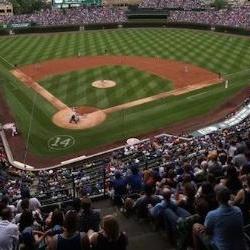
Chicago Cubs

2003 Chicago Cubs

In 2003, the Chicago Cubs made history. Their playoff victory against the Atlanta Braves in first round was the first time the Cubbies won a postseason series since 1908.

Further, 2003 is only the Cubs fourth outing to the postseason since 1945 when they played in the World Series. And it's the first time the Cubs have won a division title at home since Sept 20, 1932.

No major league team has continuously represented the same city longer than the Chicago Cubs and their predecessors, who date back to 1870. Chicago's first star was Cap Anson, one of the premier batsman of the 19th century, who led the team to the first championship of the National League in 1876.

Chicago fielded many powerful teams from 1876 to 1910. In 1907 and 1908 the Cubs won consecutive World Series titles, but since then the team has established the longest championship drought in major league baseball. Through the decades many standouts have played in Chicago, including Hall of Fame members Ernie Banks, Kiki Cuyler, Rogers Hornsby, Ferguson Jenkins, Hack Wilson, and Billy Williams. Later stars included Andre Dawson, Ryne Sandberg, and Sammy Sosa.

The Chicago White Stockings club, the predecessor of the Cubs, was formed in 1870 to challenge the Cincinnati Red Stockings (now the Reds), baseball's first professional team. The first professional league, the National Association, was founded the next year. Frustrated by players jumping from one team to another in search of higher pay, White Stockings president William Hulbert founded the National League in 1876 to provide regularly scheduled games, professional umpires, and better relations between players and owners. The team's first manager was Albert Spalding, a star pitcher who left the game in 1878 to build his sporting goods company. Anson replaced Spalding and led the White Stockings to five NL titles during his first seven years as manager.

With young, inexperienced players Chicago's record remained unimpressive during the late 1890s. Two name changes—to the Colts in 1890 and the Orphans in 1898—reflected the roster. After a sportswriter noted that the team played like bear cubs, the team adopted the name Cubs in 1902. The change marked the beginning of Chicago's second dynasty. Under managers Frank Selee and Frank Chance, the Chicago Cubs earned four NL pennants and two World Series victories from 1902 to 1912. Chicago's pitching ace during this period was Three Finger Brown. In 1906 the Cubs captured the NL pennant after winning 116 games to set an all-time major league record, although they lost to the Chicago White Sox in the World Series.

With great pitching and powerful hitting, the Cubs continued to dominate the NL. Led by first baseman-manager Chance, the team won two more NL pennants and defeated the Detroit Tigers for two World Series championships in 1907 and 1908. Chicago won two more pennants in 1910 and 1918.

In 1921 the team was purchased by William Wrigley, a Chicago chewing gum manufacturer. Wrigley invested thousands of dollars in the team, bringing together infielder Hornsby and outfielders Wilson and Cuyler under manager Joe McCarthy. Led by the strong batting skills of Hornsby and Wilson, Chicago won the NL pennant in 1929 before falling to the Philadelphia Athletics in the World Series. Chicago went on to capture four more pennants in 1932, 1935, 1938, and 1945 but was defeated each time in the World Series.

After the 1945 defeat, Chicago fell to the bottom of the NL despite the contributions of several future Hall of Fame players. Ernie Banks, who joined the team in 1953, became one of the greatest power-hitting shortstops in major league history, although he never played in a postseason game. Known simply as Mr. Cub, Banks in 1958 became the first member of a team with a losing record to be named the NL's most valuable player (MVP). A year later he became the first NL player to win back-to-back MVP awards.

Playing alongside Banks for many years were outfielder Billy Williams and third baseman Ron Santo. During a seven-season stretch in the 1960s, Williams set an NL record by appearing in 1117 consecutive games. (Steve Garvey of the San Diego Padres set a new record in 1983 with 1207). Santo, a five-time Gold Glove Award winner for fielding excellence, ranks among Chicago's all-time leaders in hits, home runs, runs batted in (RBIs), and extra-base hits. Leading the Cub's pitching staff during the late 1960s and early 1970s was Ferguson Jenkins. He recorded six consecutive 20-win seasons from 1967 to 1972, capturing the NL Cy Young Award in 1971.

In 1984 the Cubs made their first postseason appearance in 39 years, although they lost in the NL Championship Series to the San Diego Padres. Second baseman Ryne Sandberg was named NL MVP, pitcher Rick Sutcliffe won the Cy Young Award, and Jim Frey was named the league's manager of the year.

In 1987 outfielder Andre Dawson was named NL MVP in his first season with the Cubs. Don Zimmer took over as manager in 1989 and led the Cubs to another division title, assisted by pitcher Greg Maddux. The team lost in the playoffs to the San Francisco Giants, although Zimmer was named manager of the year and outfielder Jerome Walton was named rookie of the year. Maddux won the Cy Young Award in 1992. Through the mid-1990s, the Cubs failed to lead their division. In 1997 the Cubs lost the first 14 games of the season to set a record for the worst start in NL history.

In 1998 the Cubs won 90 games, led by the hitting of Sammy Sosa and the pitching of rookie Kerry Wood. Throughout the season Sosa and St. Louis Cardinals first baseman Mark McGwire chased the 37-year-old single-season home run record of 61 set by Roger Maris in 1961. Sosa finished the season with 66 home runs and McGwire finished with 70. Wood was named rookie of the year. In one game, he struck out 20 batters, tying the major league record. The Cubs lost in the first round of the playoffs to the Atlanta Braves.

In 2003, the Cubs fell to the Florida Marlins in the National League Championship Series 4-3. The Marlins went on to win the World Series.


Find Chicago Cubs in Chicago, IL Tickets!

HOT TICKETS!

Events by City

Discount Newsletter

Sign up for email updates


Learn More   See Sample

Chicago Cubs Tickets - Team Schedules, Information
Customer Service toll-free 1-866-353-5167
Use of this site is subject to express terms of use, which prohibit commercial use of this site. By continuing past this page, you agree to abide by these terms.
© 2009 Coast To Coast Tickets LLC. All rights reserved.

Coast To Coast Tickets LLC provides an online ticket marketplace offering premium event tickets for sale on the secondary market. Prices reflected on this site are determined by the buyers and sellers and may be substantially higher than the face value printed on the ticket. CoastToCoastTickets.com contains event and concert tour dates, as well as team information and game schedules for every sport. We are not affiliated with any box office, venue, sponsor, team, performer, Ticketmaster.com, or other organization. Any trademarked terms that appear on this page are used for descriptive purposes only.